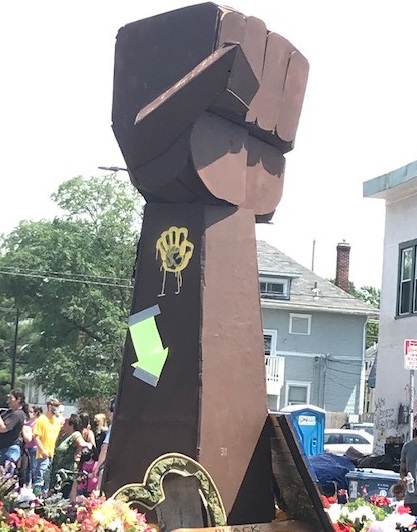
In the wake of terrorists

This weekend, I walked in the footsteps of peaceful protest and in the wake of terrorists.  I saw the best of humanity and its seedy underbelly. It felt too invasive to take photos of the annihilation and impossible to capture the breadth of love.

A man on the radio said: ”Do what you can do. If you can give time, do it. If you can give food, do it.”

When George Floyd was murdered, I emailed two colleagues of color and expressing my feelings and asking what I could do to help. I realize now, I was put my feelings of helplessness on them. My feelings of anger on them.

I see now, my best intentions of compassion weren’t helping. They were hurting. It’s not on the oppressed to tell us what to do to make it better. It’s on all of us to just make it better. When I realized this, I stopped crying in outrage, took of the blinders and started to forge my own path instead of standing by like a helpless bystander. Here’s what I wrote to each of them with open eyes, not just an open heart.

First, I’m sorry. I’m sorry I put my helplessness on you.

I live blocks from the site of George’s murder and 13 blocks from Lake Street. I oscillated between nausea and rage-crying from the moment the shock wore off from seeing the video.

On Friday night, I forced myself to keep my eyes and ears open while fight or flight took hold of me.

We relocated our kids to be with my sister-in-law in the suburbs for the night, but I sobbed when I hung up on FaceTime after seeing my boy scared and just wanting me. This, I thought, is a taste of the fear every black son’s mother might feel when her baby goes out on Friday night with friends.

I opened my window and laid in bed in the dark listening to bangs and helicopters for hours and thought, this is a sample of the alert a person of color might feel. All. The. Time.

Some elitist guy I knew from college “unfriended” me on Facebook after I grew a pair and pushed back on his “us vs. them” veiled racist response to one of my posts. And when he unfriended me, I didn’t feel bad, I felt proud. And then I posted a screenshot of our interaction so everyone we know could see what “Minnesota Nice” racism looks like. And all of our mutual people didn’t miss what a piece of crap this guy is.  Just in case they missed it the first time. 

I woke up before the sun on Saturday morning and willed the clock to move faster so I could go hold my babies.

More importantly, I woke up in other ways. My safety has been threatened to which I say: Good. It’s the only way change will be made both internally and externally. This was the pledge I made:

George Floyd’s murder will burn in my heart and fuel the change that will ripple out from me and I hope, been seen by everyone in my sphere of influence. I’ll start with a good, hard look in the mirror to begin paying attention to the white noise filter of racism I’m surely find.

I’m done asking “what can I do?” Because if I feel helpless by sitting my duff and waiting for a guidebook to lead me by the nose, well, I’m just repeating history and that’s not good enough.

If you – as a man that I respect and care about not because of the color of your skin but for the radiance of your heart and power of your brain – need anything, please tap me. Otherwise, the next time I reach out to you it will be for things like professional collaboration or parental advice – not on how to be a decent human being.

A city on fire

Civil unrest in Minneapolis reaches fever pitch the Friday after George Floyd was murdered.

The city I love is on fire for one reason: We never cared enough to stop hurting people because of their DNA. My safety has been threatened to which I say: Good. It’s the only way change will be made. My house could be replaced; George Floyd, et al cannot be.

George Floyd’s murder will burn in my heart and mind and fuel the change that will ripple out from me and I hope, be seen by everyone in my sphere of influence. I will start with a good hard look in the mirror to begin listening to the white noise of racism I’m sure I will find.

#GeorgeFloyd

Mantra of self-loathing

You’re being stupid. You’re being stupid. You’re being stupid.

“…I’d like to assess if what I do is considered a binge eating disorder.” Was the punchline in the email I sent to a local eating disorder treatment center late last night.

I mustered the courage to call a few minutes ago, but the group was all in a meeting. On the verge of tears, I sputtered that I’d just call back rather than leave a number.

I hate myself. And I eat like I hate myself.

I’m ashamed.

I’ve been doing this my whole life. Binging. Frenetically. Squirreling away food. Unable to leave a crumb behind. Focused, driven to accomplish the end.

It’s disciplined. Private. No one knows.

When I come out of it, I don’t have the courage to purge. I’ve failed at that too.

I’m failing. Everything. Everywhere.

At the end of the day, I think “it’s been a good run.”

The plane takes off, I think “it would be okay if it ended now.”

In any moment of happiness, I think “best to drop the curtain now.”

Then I angrily fight back the tears and hurt myself until it stops. Until I can regain my composure.

You’re being stupid. You’re being stupid. You’re being stupid.

.5 FTG

Collectively, TB and I bring two grandparents to the table. Two grandmothers who, together are the equivalent of maybe half of an active grandparent.

Might be easier to say that they suuuck.

TB’s mom was 45 minutes late, talked about herself the whole time, then abruptly left an hour later to “go have dinner.”

My mom is a horseshit parent and a terrible grandparent.

So now, I’m sitting in my car fighting tears because, well, I don’t want to try to explain to my 3yo that her grandmas are shitty. Or talk about how terrible TB’s mom is.

Fuck them. This is why I don’t waste my or my kids time visiting my mom. Who I think I’ll just start calling by her first name. Fuck you, Ginger.

Awkwardly Kind

I learned to be compassionate by watching my mom. Ginger’s 5’1″ body houses a mammoth heart.

When I was growing up, she was sometimes (okay, frequently) uncomfortably kind to strangers and acquaintances.

I suspect she overcompensated for the lack of kindness she experienced. And I cast no stones; I’m the same way. It’s taken me most of my 40-years to recognize and temper it.

“Is this too Gingerly?” is something I ask my husband and best friend to gauge the awkwardness of an idea.

For instance, my aunt passed away recently. We weren’t close, but reconnected after she shared her cancer diagnosis last year. She liked pictures/videos of and FaceTime with my family so I tried to do that regularly. It helped that my daughter is a particularly entertaining 3.5yo who doesn’t really get the concept of dying and provided much needed comedy to tragedy.

SIDE STORY: We were recording a video for Marilyn when she entered the hospital for the last time. We were wishing her a good night when my baby’s brow suddenly furrowed. “You messed up my room. That wasn’t very nice.” She scolded.

In the background, I’m failing to stifle a smile. “Baby, we’re talking to Auntie Marilyn, not the cleaning lady.” Apparently, we had flipped from wishing Marilyn sweet dreams to airing grievances to the sweet woman who cleans our house. She takes the time to arrange the mosh pit of stuffed animals that blanket my child’s bed, clearly to her dismay.

My uncle is now a widower and my 24yo cousin‘s mom is gone. These aren’t two people I know well but am fighting the need to smother with acts of kindness. I want to make ridiculous amounts of food, send cards and emails and care package, shovel/mow/rake, invite them for dinner, clean their house, something — ANY-thing to take away the pain.

“Too Gingerly,” my husband says. “But, what if I …” I protest. “Too Gingerly,” he counters every time. And I begrudgingly listen. Because he’s right. There’s nothing I can do to take away the pain.

However, I’m thankful that extreme kindness is ingrained in me. I would rather err on the side of awkwardly compassionate anyway.

Chosen family

My best friend in college showed me what safety is.

A boyfriend showed me the right way to be loved.

Two friends took me into their home, made me their family and gave me a sanctuary.

My best friend acts as a kickstand when I teeter.

My husband embraces all parts of who I am.

My friends have shared their parents with me. Those parents have given me basic needs.

Look for the helpers

“Look for the helpers. You will always find people who are helping.” – Mister Rogers

Easter was the first holiday after I broke the silence. I was 26 and the fallout meant I would spend the day alone. While prepared to do so, it still hurt.

I declined many sweet offers from friends to join their families. I was still too ashamed.

Forever, I will be grateful to one friend who – in the most loving way possible – bullied me into Easter with her family. On the drive back to my house, I wept quiet tears because for that moment, kindness eclipsed everything else.

Omitting the why and subsequent tears, I told that story at her wedding. That single act of determined compassion and kindness still makes me misty.

Look for the helpers.

Maslow got it

Safety is second only to food, water and sleep in Maslow’s Hierarchy of Needs. And in the wake of sexual assault, I never felt safe.

I felt most vulnerable on the brink of sleep. Today, the reason falling asleep was difficult is clear. But at the time, I did what people do; I found a way to avoid that feeling.

Moving targets are less vulnerable and allow little time for intrusive thoughts. So, I never stopped moving. My schedule was ridiculous. I habitually exhausted myself so I’d be too tired to think.

The first time I remember falling asleep on my terms was next to my best friend in college. Everyone assumed “we’re just friends” really meant he and I were sleeping together. And we were, but not like that.

I gravitated to the safety of his side. Especially in times vulnerability: Whenever I planned to drink a lot, in the event of unwanted male attention, at night and so on. He protected me. We never talked about it. He just let me be near him. And the safety he gave me was something no other person had done in my life.

I did not make it this far on my own. So many friends propped me up, held me close to their hearts and even carried me when the paralysis of shame or fear set in.

And most of them don’t even know the impact of their kindness and compassion – they are just simply extraordinary people I’ve been so lucky to have found.

The Tipping Point

In the before times, I was:
Silenced by shame.

Imploded by hate.

Terrified by a secret.

Sparked by “Why do you always call your dad an asshole?”

Fueled by standing up for myself.

Devastated by apathy.

Then I was:
Baffled by the 2016 election; though I stayed quiet.

Disgusted by the #metoo stories; yet I didn’t speak up.

Appalled by the dismissal of Dr. Ford; and my anger percolated.

Horrified by seeing a friend and meeting her brother — both raped daily by their father; and my fury simmered.

Crushed to learn when my friend posted about her own sexual assault as a preschooler …

And finally, finally, I exploded:

Capture

Wanted: Agitator

The job

  1. Acknowledge that I cannot eat crap food. Bad things happen every time.
  2. Come to believe I am a) worth living happily b) that I have the power to do things differently.
  3. Become willing to do things differently and make healthy choices in my thoughts, behaviors and actions through various methods.
  4. Look at the patterns of thought and behavior that don’t serve me.
  5. Reflect on these patterns, discuss them with someone if necessary and fully acknowledge that these things harm me and cannot continue.
  6. Become willing to surrender these negative patterns of thought, behavior and actions.
  7. Take the necessary action to change these maladaptive patterns, to end unhealthy relationships and continue to take action that leads me to wellness.
  8. Make a list of persons I have harmed and become willing to make amends to them.
  9. Make direct amends to such people.
  10. Continue to watch for maladaptive behavior, without judgement, and take action to change it.
  11. Involve myself in positive activities
  12. Live an example of a positive, openhearted, honest, ethical life.

The pitch

Good afternoon,

I’m seeking a new therapist.

I am a 41yo woman with a history of trauma, long-term childhood sexual and emotional abuse, and a buffet of other experiences that resulted in a generalized anxiety disorder, depression and PTSD. Plus, two stints of PPD.

The goal is simple: I want to put the past and all of the fallout from it to rest. While all my experiences shaped who I am today – and I like who I am – I’m exhausted by their intrusive presence and continued impact on my present-day life. I’m done with treating the symptoms – I want to treat the cause.

But, the challenge is twofold:

  1. I present well. Too well. I’m likable. My story is crappy and I’m uncontrollably genuine such that most therapists can’t help but want to nurture me. But I need someone who is both kind and gentle but also knows when to push, agitate and dig in and not let up.
  2. I need more than talk therapy. Should we talk for three hours at a time? Sure. Do you have homework for me? Great. Do you have some DBT, visualization, 12-step, EMDR, Eastern medicine program you want me to try? Let’s do it – but you have to assign and hold me accountable. I appreciate readings, but photocopied pages of chapters is not how I learn.

So, if you are interested in my case, I’d like to meet you for a quick meeting to see if we jive.  If we move forward, I am happy to sign an ROI so you can read my past therapy notes so we can be an efficient team.

I need an agitator.